

Trucking Crash Evidence: What We Collect and Why
Truck accident cases are won or lost on evidence the carrier controls. Black box data, ELD logs, maintenance records, and driver qualification files — all of it can disappear once the truck returns to service. We act immediately to preserve every piece before the carrier has a chance to let it vanish.
Truck accident cases are fundamentally different from car accident cases — not just in severity, but in how the case is built. A trucking crash typically involves a technical sequence of failures: a driver who exceeded their hours, a truck with deferred brake maintenance, a carrier that knew about both and dispatched anyway. Proving that sequence requires access to records the carrier controls and can legally destroy if not put on notice. Our team sends a preservation letter on day one, targeting every category of evidence before it disappears.
Why Trucking Evidence Disappears So Quickly
Commercial truck carriers are not legally required to retain most records indefinitely. The FMCSA sets minimum retention periods — and some data, like ECM/black box readings, begins overwriting as soon as the truck returns to service. Other records — like dash cam footage stored on a rolling loop — may only hold 72 hours of data. The preservation letter our team sends on day one creates a legal duty for the carrier to hold everything. After that, any destruction becomes spoliation — and spoliation creates its own legal consequences in a Kentucky court.
The Critical Evidence Categories in Every Trucking Case
1. Black Box / ECM / EDR Data
Almost all modern commercial trucks are equipped with an Engine Control Module (ECM) or Event Data Recorder (EDR) — commonly called the “black box.” This device records speed, throttle position, brake application, engine RPM, and crash force data for the seconds before and during a collision. Black box data is the most objective evidence of what the truck was doing at the moment of impact — and it is subject to overwriting once the engine runs again. Extraction must happen fast.
2. ELD / Hours of Service Logs — 49 CFR Part 395
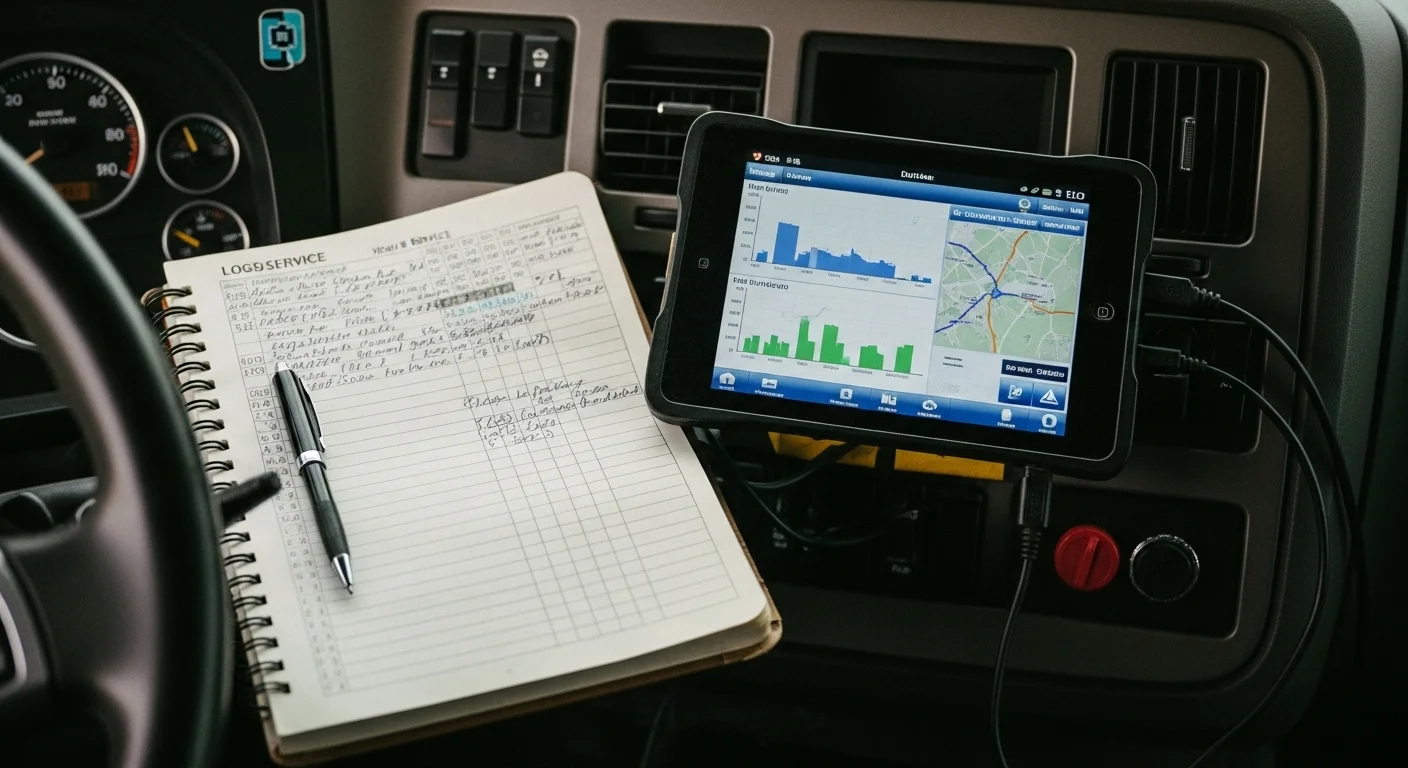
Electronic Logging Devices automatically record every change in a driver’s duty status — driving, on-duty not driving, off-duty, sleeper berth. Required by the FMCSA since 2017, ELD data is timestamped and tamper-resistant. After a crash, it tells us whether the driver was within their legal driving hours, when they last had required rest, and whether prior hours of service violations appear in the days before the crash. A pattern of violations in the same ELD history points directly at carrier-level negligence.
3. Dash Camera and Surveillance Footage
Forward-facing and in-cab cameras capture the driver’s behavior, road conditions, and the crash itself. Many carriers use third-party camera systems that stream footage to a server — meaning the footage may be accessible even if the in-cab device is damaged. We subpoena third-party camera vendors and pull 911 call data and CAD logs that can identify nearby surveillance systems — traffic cameras, business cameras, and emergency dispatch footage that captured the incident.
4. Driver Phone Records
Under 49 CFR 392.82, commercial truck drivers are prohibited from using handheld mobile devices while driving. Phone records subpoenaed through discovery show call logs, text messages, and data usage timestamped against the moment of impact. A single text sent while the truck was moving is evidence of a $2,750-per-violation federal infraction — and proof of distracted driving.
5. Vehicle Maintenance Records — 49 CFR Part 396
Federal law requires carriers to systematically maintain every vehicle and document that maintenance. Pre-trip and post-trip inspection reports — Driver Vehicle Inspection Reports (DVIRs) — show what defects were known, when they were reported, and whether the carrier repaired them or put the truck back on the road anyway. A brake defect flagged by a driver and ignored by the carrier is powerful evidence. A brake failure that caused a crash is the result.
6. Driver Qualification File — 49 CFR Part 391
Every CDL driver employed by a carrier must have a complete qualification file — employment application, motor vehicle record, road test certificate, medical examiner’s certificate, and prior employment history. Driver qualification violations include hiring a driver whose medical certificate had expired, ignoring a prior DUI on the motor vehicle record, or skipping the road test entirely. When the carrier knew or should have known the driver was unqualified, the carrier bears direct liability for what that driver does.
7. Cargo Securement Records — 49 CFR Part 393
When improper cargo securement contributes to a crash — a shifted load causing a rollover, debris striking a following vehicle — the carrier’s cargo documentation, loading records, and inspection reports become critical evidence. Shippers and brokers who were responsible for loading may also face liability.
8. FMCSA Safety Ratings and Prior Violations
The FMCSA’s Safety Measurement System (SMS) publicly tracks carrier safety performance — including prior roadside inspection violations, out-of-service orders, and crash history. A carrier with poor SMS scores in the maintenance or HOS compliance categories was on notice that its vehicles or its driver practices posed a risk. That notice matters enormously in a punitive damages context.
What Our Investigation Targets From Day One
- ECM/EDR black box data — extracted before engine restart overwrites the record
- ELD logs — hours of service compliance, duty status, and prior violations
- Dash cam footage — in-cab and forward-facing, including third-party server backups
- Driver phone records — subpoenaed to capture all activity at the time of impact
- Maintenance records and DVIRs — documenting known defects and the carrier’s response
- Driver qualification file — hiring, licensing, medical certification, and employment history
- FMCSA carrier SMS data — prior violations, out-of-service orders, crash history
- Cargo loading and securement records — shipper documentation, broker agreements
- Law enforcement body camera footage and CAD logs — capturing driver demeanor and scene conditions
- Telematics and fleet management data — fleet management systems may record GPS position, speed, and alerts in real time
The Role of Professional Witnesses in Trucking Cases
Once evidence is secured, our team works with technical professionals in the fields of accident reconstruction, human factors, and trucking safety standards. An accident reconstructionist can establish pre-impact speed and braking based on physical evidence and black box data. Trucking safety witnesses analyze the carrier’s compliance failures against industry standards. Medical witnesses document the connection between the crash forces and your specific injuries.
The preservation letter is step one. Every hour after a crash that passes without one is an hour the carrier is under no legal obligation to hold the evidence. Our team goes out immediately — so when discovery opens, the record is intact.
Frequently Asked Questions
What is a black box in a semi-truck and what data does it hold?
A semi-truck’s black box — formally an ECM (Engine Control Module) or EDR (Event Data Recorder) — captures pre-impact data including vehicle speed, throttle position, engine RPM, brake application, and crash force measurements for the final seconds before and during a collision. This data is objective and carrier-independent. It must be extracted before the truck returns to service, as the ECM begins overwriting data as soon as the engine runs again. A preservation letter and, if necessary, an emergency court order are used to secure it immediately.
How long does a trucking company have to keep driver records?
FMCSA regulations set minimum retention periods: driver qualification files must be retained for the duration of employment plus three years (49 CFR 391.51); driver vehicle inspection reports (DVIRs) must be retained for three months (49 CFR 396.11); hours of service records (ELD data) must be retained for six months (49 CFR 395.8). After a crash, a preservation letter extends these obligations indefinitely until the legal matter is resolved. Destruction after notice of a claim constitutes spoliation.
What happens if the trucking company destroys evidence?
When a carrier receives notice of a claim and destroys evidence, it constitutes spoliation. Under Kentucky law, a court can give the jury an adverse inference instruction — telling the jury it may presume the destroyed evidence would have been unfavorable to the carrier. In egregious cases, spoliation can result in case-dispositive sanctions against the carrier. Carriers know this, which is why a well-timed preservation letter matters so much.
Can the carrier’s prior safety violations be used in my case?
Yes. Prior FMCSA violations, out-of-service orders, and poor Safety Measurement System (SMS) scores are admissible evidence of the carrier’s knowledge and pattern of conduct. A carrier with a history of HOS violations who dispatched a fatigued driver was on notice that its practices created risk. That notice supports both negligence and punitive damages claims. We pull carrier SMS data as part of every trucking crash investigation.
Tell Us What Happened
Our team will review your truck accident and reach out to discuss your options — no upfront cost, no obligation.