

TRUCK TALK
Rapid Response Teams After Truck Accidents

A collision between a passenger vehicle and an 80,000-pound commercial truck isn’t investigated the same way as a fender-bender. The regulatory framework alone creates a paper trail that doesn’t exist in ordinary auto cases.
Federal Records in a Truck Accident Investigation
Commercial truck operations are governed by the FMCSA’s Federal Motor Carrier Safety Regulations (FMCSRs), found at 49 CFR Parts 390, 399. These regulations require carriers to maintain detailed records on drivers, vehicles, loads, and operations. When an accident happens, that data becomes evidence, but only if it’s preserved. The Lexington truck accident lawyer page covers the federal records behind those cases.
The trucking company’s insurer and legal team typically respond to serious accidents within hours. They send claims investigators and, in major accidents, accident reconstruction teams. The purpose is partly to document the scene, but also to control the narrative before victims and their attorneys can build their own picture. That’s why our team moves early.
ECM and ELD Black Box Data
Every modern commercial truck has an Electronic Control Module (ECM), the truck’s “black box.” It records engine data, vehicle speed, braking activity, throttle position, and cruise control status in the seconds before an accident. Depending on the system, ECM data can show:
The truck’s speed at the time of impact
Whether brakes were applied and how hard
Whether the driver was over hours based on engine activity
Cruise control engagement status
Hard braking events in the period before the accident
Beyond the ECM, trucks subject to FMCSA hours-of-service rules must use Electronic Logging Devices (ELDs). ELD data shows driving time, on-duty time, rest periods, and vehicle movement. Under 49 CFR Part 395, ELD records must be retained for at least six months, but six months isn’t long for a case that may take years to resolve. Fleet Management Systems (FMS) used by larger carriers go further, recording GPS position, speed alerts, harsh braking events, and communication between drivers and dispatch.
Driver Logs and Hours-of-Service Records
Under FMCSA regulations, commercial truck drivers are subject to strict hours-of-service limits designed to prevent fatigued driving. Key limits from FMCSA’s hours-of-service rules include:
11 hours maximum driving after 10 consecutive off-duty hours
14-hour on-duty window, the clock doesn’t stop for breaks
30-minute rest break required after 8 hours of driving
60/70-hour weekly limits depending on the carrier’s schedule
HOS violations are one of the most common contributing factors in serious truck accidents. In litigation, HOS records are obtained through ELD data, paper logs in exempted operations, carrier dispatch records, trip reports, and cell phone GPS data corroborating driver location and movement. For cases involving fatigue, our page on hours-of-service violations covers the federal rules in detail.
Qualification Files
Under 49 CFR Part 391, carriers must maintain a Driver Qualification File (DQF) for every driver. This file includes:
CDL verification and current status
Medical examiner certificate (physical qualification)
Driver’s license record and MVR checks
Pre-employment drug test results
Employment history and background check documentation
The DQF can reveal whether the driver should have been on the road at all. Medical disqualifications, expired CDL endorsements, prior DUI or reckless driving convictions, and failed drug screenings all appear in this file. When a carrier fails to properly screen or qualify a driver, and that driver causes an accident, the carrier faces liability for negligent hiring and retention. Our page on driver qualification violations explains how those standards apply.
Vehicle Maintenance Records
Commercial trucks are required by 49 CFR Part 396 to be maintained in safe operating condition. Carriers must keep:
Periodic inspection records
Records of vehicle defects identified and repaired
Driver Vehicle Inspection Reports (DVIRs), pre- and post-trip inspections
Out-of-service order documentation and repair records
The FMCSA’s Large Truck Crash Causation Study (LTCCS) found brake problems in a significant portion of accident-involved vehicles. When maintenance records show a known defect went unaddressed, or DVIRs were never completed, that supports both negligence and a broader failure-to-maintain argument against the carrier.
ECM data can be overwritten by subsequent driving activity within days
ELD data has a six-month retention minimum, cases take longer
DVIRs are kept for just three months under federal regulations
Cell phone records must be subpoenaed before carriers routinely delete them
Dashcam footage is often overwritten on 72-hour loops
Carrier Safety History
Every carrier registered with FMCSA has a publicly searchable safety profile through the SAFER Web portal and the CSA Safety Measurement System. This data includes accident history, roadside inspection results and OOS rates, BASIC scores, and enforcement history.
A carrier with high CSA scores in Vehicle Maintenance or Hours-of-Service Compliance is on FMCSA’s radar for a reason. That history shows the accident wasn’t an isolated incident, it was the predictable result of a pattern of safety failures. This evidence supports arguments for punitive damages when carrier conduct was especially reckless.
Accident Reconstruction
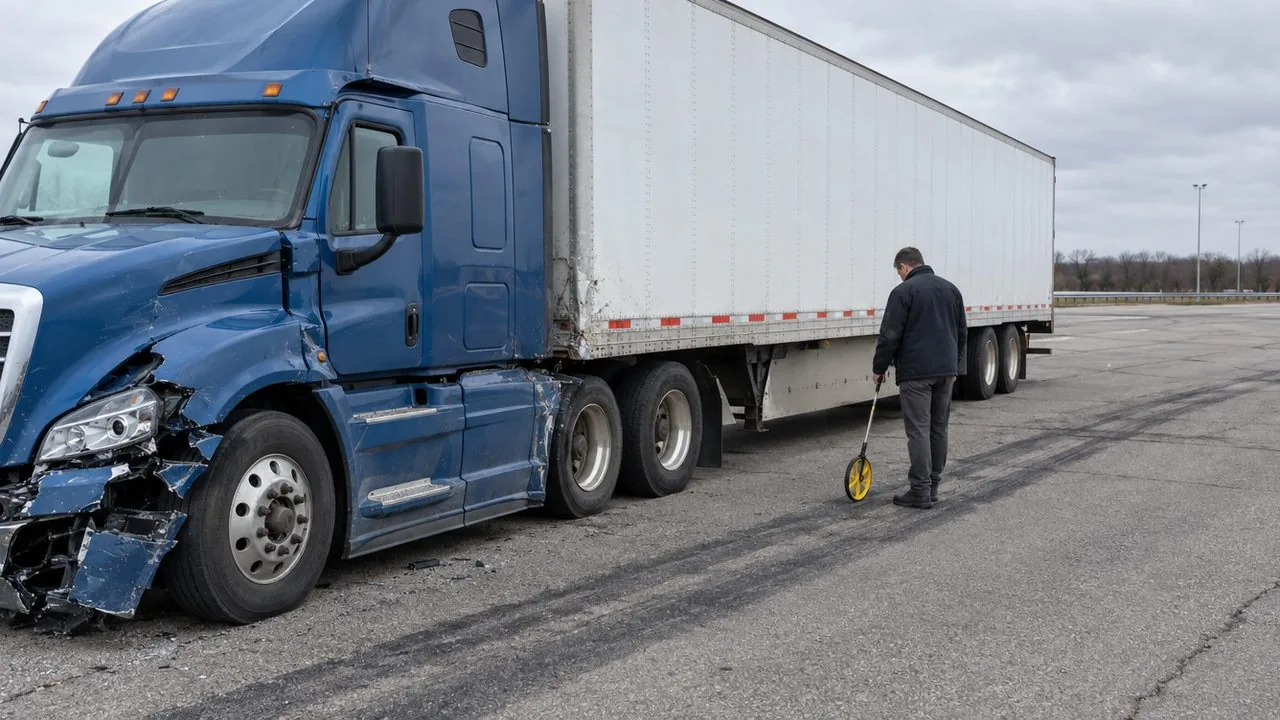
In major truck accident cases, physical evidence analysis, tire marks, point of impact, debris field, roadway geometry, is combined with electronic data to reconstruct exactly what happened. Accident reconstruction professionals use physics-based modeling, ECM data downloads, and scene documentation to establish pre-impact speed, braking and evasive action, line of sight and reaction time analysis, and whether driver behavior or vehicle condition caused the accident.
Trucking Expert Witness Matchmaker
Select the questions in dispute to see which disciplines may apply.
Issue and Discipline Matrix
Speed, movement, impact sequence
Accident reconstruction. Vehicle paths, measurements, timing, and assumptions.
Lane position and contact sequence
Accident reconstruction. Lane position, contact order, and the assumptions behind them.
Brakes, tires, coupling, repairs
Heavy-vehicle mechanic or mechanical engineer. Component condition and mechanical issues within the person’s qualifications.
Phone or electronic timing
Digital forensics. Device records, metadata, attribution, and timestamp limitations.
Medical certification
Qualified medical examiner or occupational-medicine professional. Applicable medical qualification and certification questions.
Perception, visibility, response
Human factors. Human perception and response questions under supported conditions.
Fleet practices, dispatch, hiring, hours of service
Motor-carrier safety professional. Operational practices and records within the person’s qualifications.
Injury mechanics
Biomechanics. Forces and occupant movement. This match does not extend to a clinical diagnosis.
Future care
Life-care planning and appropriate clinical disciplines. Supported care needs and planning assumptions.
Work capacity
Vocational analysis. Employment capacity and vocational evidence.
Economic loss
Economics. Financial assumptions and calculations.
Demonstrative exhibits
Visualization. Illustrations based on identified evidence and opinions, not literal recordings.
Results are ordered by how many selected issues match each discipline, then by discipline name from A to Z. This is a simple sorting rule, not a prediction of what a case needs.
Federal Rule of Evidence 702 requires qualifications, helpfulness, sufficient facts or data, reliable methods, and reliable application. A discipline label is not admissibility.
For deeper coverage of specific evidence types, see our pages on trucking evidence, FMS data in truck accident investigations, and our overview of the data puzzle pieces in accident investigation.
Commercial Truck Litigation Counsel
Handling catastrophic commercial truck collisions requires thorough knowledge of the Federal Motor Carrier Safety Regulations, digital evidence preservation requirements, and corporate motor carrier discovery practices. Jon Hollan and Sam Aguiar maintain selection in the Trucking Trial Lawyers Association Top 10, directing complex commercial vehicle investigations against national transportation carriers.
Under the Bigger Share Guarantee®, our clients always walk away with more money than the firm after medical bills, liens, and case expenses are paid. If a client’s share would ever be less than the legal fee, the firm cuts its fee. Every case receives a dedicated three-person team: a top-rated attorney, an experienced case manager, and a skilled legal assistant. We work under a flat contingency fee that never increases if your case goes to trial, with $0 out-of-pocket expenses forever.
Insurance companies push settlement releases quickly after a commercial wreck because an injury release is permanent. Once signed, the insurance claim is closed forever, leaving injured people to pay future medical expenses out of pocket. For a free case review, contact Sam Aguiar Injury Lawyers in Louisville at (502) 888-8888 or in Lexington at (859) 888-8000. Get more. Get it faster. Get it with Sam Aguiar.
Why Kentucky Chooses Sam Aguiar