

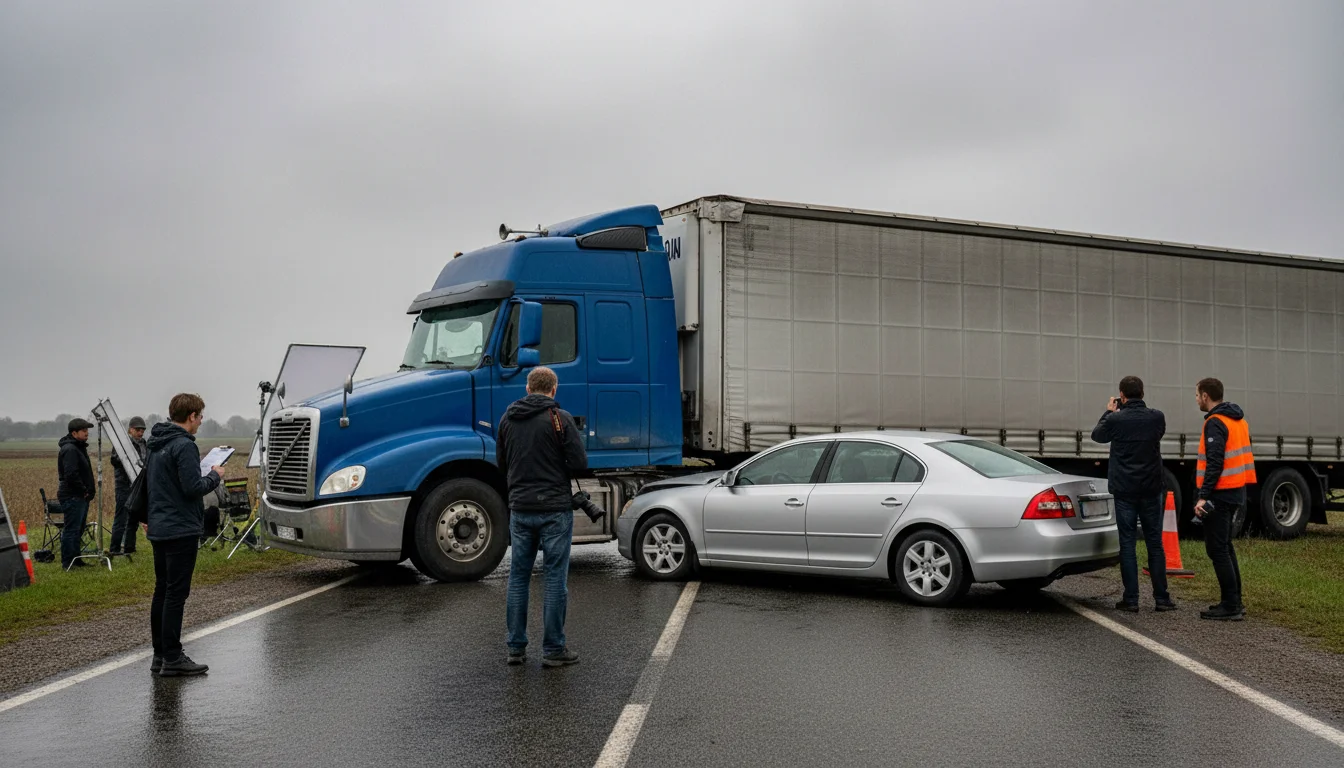
Trucking Industry Crashes in Kentucky
A semi-truck crashes and injures someone in the U.S. every 15 minutes. When it happens in Kentucky, the wreckage goes beyond the roadway — and so does the fight for full compensation.
Trucks kill and injure people at a staggering rate. According to the FMCSA’s Large Truck and Bus Crash Facts, 156,553 large truck crashes were reported nationally in 2023, killing 4,807 people. In Kentucky alone, Kentucky State Police data shows trucks were involved in 9,736 collisions — and 99 of those were fatal, accounting for 13% of all fatal collisions statewide. Of those killed, 70% were occupants of the other vehicle, not the truck. That number tells the story: when a semi hits a passenger car, it’s almost never the truck driver who pays the heaviest price.
The Scale of Trucking Crashes — Nationally and in Kentucky
The U.S. trucking industry moves roughly 10 billion tons of freight per year, and the FMCSA regulates over 550,000 motor carriers. The volume is enormous — and so is the crash toll. Every 15 minutes, a large truck crash in America injures or kills someone. That’s not a headline. That’s the baseline.
(FMCSA Large Truck Crash Facts)
(FMCSA 2023 data)
(KSP 2024 Crash Facts)
(KSP 2024 Crash Facts)
Kentucky sits at the intersection of several major freight corridors — I-65, I-64, I-71, and I-75 all run through the state. Louisville’s position at the confluence of three interstates makes Jefferson County one of the highest-volume commercial truck corridors in the Southeast. The crash numbers reflect that. The top causes of big truck accidents in Kentucky track closely with national patterns, but local road conditions, weather, and dispatch culture create their own risks.
What Causes Trucking Industry Crashes?
The FMCSA’s Large Truck Crash Causation Study (LTCCS) identified the critical reason for crashes in a nationally representative sample. The breakdown:
Driver Error — 87% of Critical Reasons
The overwhelming majority of truck crashes come down to driver-related factors. The LTCCS lists the most common as: brake problems, traffic flow interruptions, prescription drug use, speeding, unfamiliarity with the roadway, fatigue, distraction, and illness. These are not random — they’re predictable failures that often trace back to carrier pressure, inadequate training, and schedule manipulation.
Vehicle-Related Defects — 10%
Brake failure leads the vehicle-defect category. Federal 49 CFR Part 393 sets mandatory equipment standards for commercial vehicles, but enforcement depends on the carrier’s maintenance culture. A truck running on worn brake linings at highway speed is a missile. Safety systems evidence — maintenance logs, inspection records, driver vehicle inspection reports (DVIRs) — often reveals patterns of neglect that existed long before the crash.
Environmental Factors — 3%
Road conditions, weather, and lighting account for a small but meaningful slice. Kentucky’s mix of interstate highways, two-lane rural roads, and mountain passes in the eastern counties creates challenges that drivers and dispatchers are expected to account for. When they don’t, liability can extend to the carrier for dispatching in unsafe conditions.
When the Carrier Shares the Blame
Driver error is often the visible cause — but the root cause is frequently a carrier that created the conditions for the crash. Federal regulations require carriers to:
- Screen driver qualification files under 49 CFR Part 391
- Maintain accurate Hours of Service records under 49 CFR Part 395
- Conduct regular vehicle inspections and maintain equipment under 49 CFR Part 396
- Remove drivers from service who have reportable violations under 49 CFR 391.15
When a carrier skips these steps to move freight faster, negligent hiring and negligent maintenance claims follow.
Why Trucking Industry Crashes Cause More Severe Injuries
Physics explains the damage. A loaded semi-truck can weigh up to 80,000 pounds under federal limits — roughly 20–25 times the weight of an average passenger car. At 65 mph, the force involved in a collision with that mass produces catastrophic results on smaller vehicles. The most common truck accident injuries include traumatic brain injury, spinal cord damage, internal organ trauma, crush injuries, and amputations. Survivors often face surgeries, months of rehabilitation, and permanent limitations on their ability to work and function.
The financial damage compounds the physical. Medical liens, lost wages, and long-term care costs can reach seven figures before a case is even filed. Insurance coverage in commercial truck cases is typically far larger than in standard car accident claims — federal minimums start at $750,000 under 49 CFR Part 387, and many carriers carry $1 million or more — but that coverage comes with teams of adjusters and defense lawyers whose job is to minimize what they pay out.
Evidence That Wins Trucking Crash Cases
Commercial truck accidents produce more recoverable evidence than almost any other type of crash — if you move fast enough to preserve it. The key evidence categories:
- ELD and Hours of Service data — Electronic logging devices record driving time, rest stops, and HOS compliance. HOS violations show the driver was legally required to stop.
- Electronic Control Module (ECM) / black box data — Captures speed, braking, throttle, and gear positions in the seconds before impact.
- Driver qualification file — Employment application, driving record, prior accident history, drug/alcohol test results. Required by federal driver qualification regulations.
- Maintenance and inspection records — DVIRs, repair orders, annual inspection certificates. Shows whether known defects were ignored.
- Fleet management system (FMS) data — Dispatch messages, location pings, and communication logs that reveal carrier pressure and routing decisions.
- FMCSA inspection and SMS data — The FMCSA’s Safety Measurement System scores carriers on safety behavior. Carriers with elevated Behavior Analysis and Safety Improvement Category (BASIC) scores have documented histories of violations.
Evidence disappears fast. Carriers are not required to preserve ELD and ECM data indefinitely. Some systems overwrite data within 30 days. Dashcam footage, weigh station records, and fuel receipts can all be lost if a spoliation letter isn’t sent immediately. Our dedicated trucking team moves within 24–48 hours of being retained to preserve the full evidence picture.
How Sam Aguiar Injury Lawyers Handles Trucking Industry Crash Cases
Trucking cases are not standard car accident cases. They involve federal regulations, multiple defendants, commercial insurers with in-house defense teams, and evidence that must be preserved on a tight timeline. Our dedicated trucking and commercial vehicle team handles every step from initial evidence preservation through trial, if necessary.
Every client gets a dedicated team of three: a top-rated attorney, a highly experienced case manager, and a dedicated legal assistant. From the moment you call, your team starts building the case — not just the demand letter. That means truck crash investigation, independent reconstruction when warranted, and detailed documentation of every aspect of the crash, your injuries, and your losses.
With our Bigger Share Guarantee®, you always take home a larger share of your settlement. We charge a no increased litigation fees contingency fee that never increases — even if your case goes to litigation. You pay $0 Out-Of-Pocket Forever. If there’s no recovery, you owe us nothing.
Frequently Asked Questions
How is a trucking crash case different from a regular car accident case?
Truck crash cases involve federal regulations under the FMCSA, multiple potential defendants (driver, carrier, cargo company, broker, maintenance provider), and commercial insurance policies that dwarf standard auto coverage. The evidence — ELDs, black boxes, driver qualification files, maintenance records — is unique to commercial vehicles and must be preserved quickly. Carriers often have rapid-response teams at the scene before families have had a chance to contact a lawyer.
Can I sue the trucking company directly?
Yes, in most cases. Carriers can be held liable for negligent hiring, negligent training, negligent supervision, and negligent maintenance — on top of vicarious liability for their driver’s conduct. In cases where a broker or shipper contributed to the conditions that caused the crash, they may also be named as defendants.
What is the minimum insurance required for commercial trucks in Kentucky?
Under federal law (49 CFR Part 387), the minimum insurance for a general freight motor carrier is $750,000. Carriers hauling hazardous materials must carry up to $5 million depending on the cargo class. Many large carriers carry $1 million or more. In practice, our team identifies all coverage layers — primary, umbrella, and excess — to ensure the full available insurance is pursued.
How soon should I contact a lawyer after a truck accident?
Immediately — or as soon as you are physically able. Evidence timelines in truck cases are measured in days, not months. ELD data can be overwritten in 30 days. Carrier-retained investigators often arrive at crash scenes within hours. The sooner our team sends a spoliation letter and begins preservation, the better.
What compensation can I recover after a truck crash in Kentucky?
Kentucky does not cap compensatory damages in personal injury cases. Recoverable amounts typically include: all past and future medical expenses, lost wages and lost earning capacity, pain and suffering, emotional distress, PTSD, permanent impairment, and property damage. In cases where the carrier’s conduct was grossly negligent — such as knowingly deploying a fatigued driver or ignoring repeated maintenance failures — Kentucky law may also allow punitive damages.
Start Your Case Review Today
Tell us what happened. Our team will reach out quickly — no appointments, no waiting rooms.