

Spaghetti Junction Accidents in Louisville
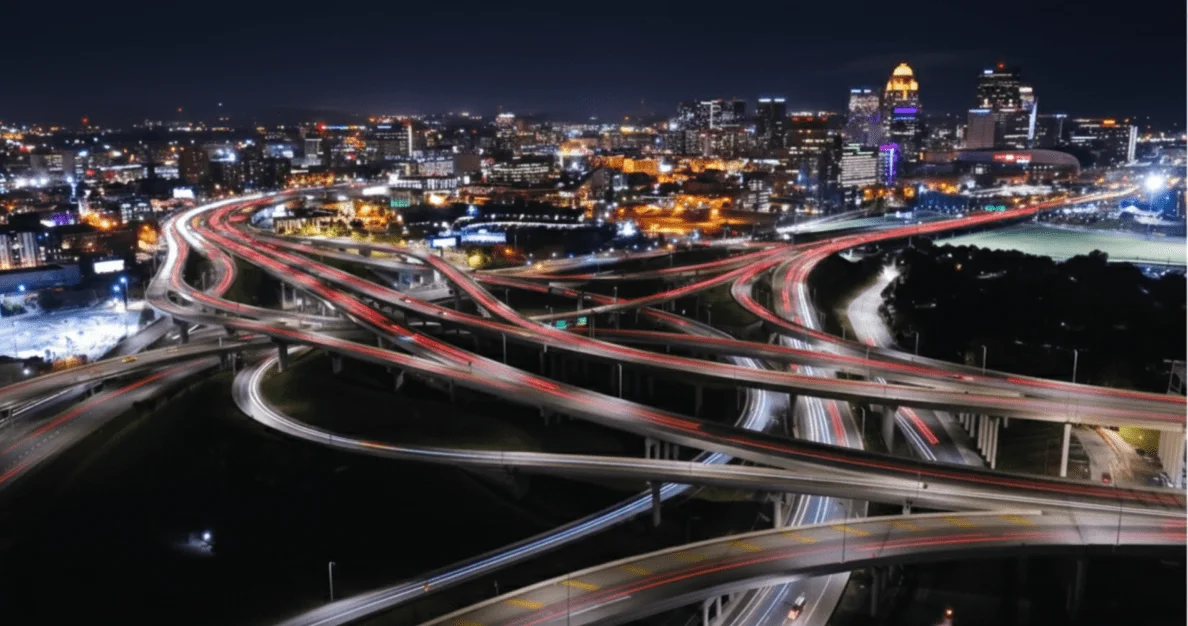
Three interstates meet in downtown Louisville inside a single interchange, and the rebuild that finished in 2016 changed the way that meeting fails. Knowing what was fixed, and what was left, is the difference between a case built on the right mechanism and one built on the obvious one.
What the Interchange Is
Spaghetti Junction is the Kennedy Interchange, and it is a convergence rather than a road.
The region’s metropolitan transportation plan describes it directly: the Kennedy Interchange operates interdependently with the Kennedy Bridge and is the convergence of Interstates 64, 65, and 71 in downtown Louisville, commonly known as Spaghetti Junction (KIPDA).
That shape produces accident types a straight corridor does not. Vehicles arrive from three directions, change lanes to reach an exit or stay on route, and do it inside a limited distance. The same plan records that the Louisville-Southern Indiana Ohio River Bridges Project, including the Downtown and East End crossings, opened to the public in 2016.
The plan also records that I-64 between the Kennedy Interchange and I-264 still has inadequate capacity and “spots of higher crashes.” Our other corridor pages cover their own ground: the Watterson Expressway corridor is a different shape of problem, and the dangerous roads roundup covers the citywide picture.
Why the Weave Was the Hazard
The planning record for this interchange does something unusual. It names the hazard it was built to fix.
The modernization of the interchange “eliminates dangerous weaves,” the KIPDA plan records. The same document describes the improvements as providing sufficient capacity for rush hour demand, adding emergency pull-off areas, and softening curves throughout the interchange to improve safety.
A weave is what happens when a vehicle entering the interstate has to cross lanes that vehicles already on the interstate are using to reach an exit, inside a distance too short for both movements to resolve comfortably. Where three interstates meet, the same stretch of pavement carries those crossings at once. The plan records the elimination of specific weaving movements, including the movements from I-64 westbound and I-71 southbound to I-65.
For a case, the history is useful context rather than a finding about any particular accident. What it establishes is that the interchange was designed around a known hazard, that the hazard was a merge and lane-change problem rather than a speeding problem, and that the geometry is still the thing that makes it distinctive.
How Accidents Happen There Now
The rebuild removed the weaves. It did not remove the convergence, and accidents there still follow from vehicles arriving at different speeds into the same space.
A driver entering from a downtown street ramp reaches interstate traffic at a speed well below the traffic already moving. That difference has to be absorbed by somebody. Where the entering driver accelerates into a gap that is closing, or where a driver already on the interstate changes lanes without accounting for an entering vehicle, the result is a sideswipe or a rear-end collision at speed.
Multi-vehicle collisions are the second pattern, and they follow from the first. An accident in a lane that cannot be avoided produces a chain, because the vehicles behind have neither the distance nor the lateral room to go around. Our rear-end collision practice covers the following-distance analysis those cases run on.
Construction is the third, and it is periodic rather than constant. Where a lane closes inside the interchange, the merge distance shortens and the speed differential widens at the same time. The construction zone practice covers how a work zone changes the standard a driver is held to.
Speed Differential and Merge Distance
The number that decides most of these cases is the difference between the speed of traffic already on the interstate and the speed of the vehicle merging into it.
Everything about the merge follows from that gap. The larger it is, the more distance the entering driver needs to close it, and the more time a driver already on the interstate needs to see and react to a vehicle appearing alongside. Where the differential is large and the available distance is short, both drivers are working with less margin than the same maneuver would have on an open rural interchange.
The reconstruction analysis follows from that. Impact configuration shows whether the collision was a sideswipe during a lane change, a rear-end at the merge point, or an angle collision across lanes. Vehicle data shows the speed of each vehicle in the seconds before impact, which is what establishes the differential rather than the estimate either driver gives afterward. Scene evidence shows where the merge point was relative to where the collision happened.
Where the puzzle is which vehicle had the right to the lane, the answer is the movement rather than the position. A vehicle established in a lane has a different expectation from one crossing into it, and that distinction shapes how fault is allocated between two drivers who each believe they were in the right.
Building a Case from Corridor Evidence
A corridor case is a records case, and the records are mostly generated before anyone thinks about a lawsuit.
The crash report is the starting document, and its diagram is the clearest statement of where each vehicle was. Vehicle data is the second, where either vehicle recorded speed, braking, or steering input. Camera coverage is the third: the corridor carries traffic cameras, and commercial vehicles in the area carry their own. Witness accounts from other drivers are the fourth, and they are perishable.
Kentucky sets required minimum tort liability insurance by statute (KRS 304.39-110), which is the floor rather than the measure of what a serious collision involves. The Motor Vehicle Reparations Act sits in Subtitle 39 of the Insurance Code.
Our approach on a corridor case is to identify every source that exists and preserve it, then build the mechanism from the reconstruction rather than from the accounts. That is the same work we do on any multi-vehicle collision, applied to an interchange where the geometry explains more than the statements do.
| Citation | Authority | Area |
|---|---|---|
| CitationKIPDA MTP | Authority Connecting Kentuckiana Names Spaghetti Junction as the Kennedy Interchange, records the 2016 Ohio River Bridges opening, and states the modernization “eliminates dangerous weaves.” | AreaInterchange |
| CitationKRS 304.39-110 | Authority Minimum tort liability Kentucky’s required minimum bodily-injury liability insurance, the floor rather than the measure of a serious interchange collision. | AreaInsurance |
| CitationSubtitle 39 | Authority Motor Vehicle Reparations Act Sits in Subtitle 39 of the Insurance Code, Chapter 304. | AreaStatute |
Sources opened and read 2026-10-08: KIPDA Connecting Kentuckiana draft plan; KRS 304.39-110 (id=46758); Chapter 304 (id=38684); Subtitle 39 (id=38757).
Louisville Interchange Case Review
Records that decide a Spaghetti Junction case can disappear: traffic-camera footage, vehicle event data, police supplements, and witness information. Sam Aguiar Injury Lawyers preserves those records and builds the case around what the evidence shows.
Frequently Asked Questions
Where is Spaghetti Junction?
Why is it called Spaghetti Junction?
Was the interchange rebuilt?
What causes accidents there now?
Latest Articles

Who Is Liable for a School Bus Accident in Kentucky?
Who answers for a Kentucky school bus accident, where the case is filed, and the 2026 stop-arm rules.
Dashcam Evidence in a Kentucky Car Accident Case
How a dashcam clip is preserved, authenticated, and used in a Kentucky car accident case.
I-65 Truck Accident Hotspots
Where I-65 truck accidents cluster in Kentucky and what evidence those corridor cases need.