

Car Accident Internal Organ Injuries
Key Takeaways
- Car accidents cause 50% to 75% of splenic ruptures, and a spleen may rupture immediately upon impact or have a delayed rupture as a result of swelling from the injury.
- Bruised skin where the seat belt restrained the occupant, the seat belt sign, is linked to a 12% chance of bowel injury.
- The majority of liver injuries heal in about 4 months, and after moderate and severe liver injuries patients may usually resume normal physical activities after 3 to 4 months.
Solid and Hollow Abdominal Organs
The spleen is a fist-sized organ in the upper left belly that stores and filters blood, and it sits under the left ribcage and the diaphragm. Its inner pulp is enclosed in a thin capsule of muscular tissue. That anatomy makes the spleen relatively easy to injure, especially by blunt trauma to the outer capsule.
The liver, the largest internal organ, is on the right side of the upper body under the ribs, just next to the stomach. In children, the spleen and liver account for approximately 70% of all visceral injuries caused by blunt trauma, by far the most commonly injured organs inside the abdomen.
Kidneys are the most vulnerable genitourinary organ in trauma and are involved in up to 3.25% of trauma patients. Each kidney is covered by fat and a layer called Gerota’s fascia in the retroperitoneum.
Crash Forces and Impact Direction
In 1993 to 1998 national crash data, side impacts accounted for more abdominal injuries than frontal impacts and occurred at somewhat lower changes in velocity. Among serious injuries, the liver was the most frequently injured organ in frontal, right side, and far side crashes, followed by the spleen, while the spleen sustained the most injuries in left side and near side impacts.
In a right side impact, the asymmetrical location of the liver, together with only partial protection by the rib cage, makes it the most vulnerable solid organ. Direct compressive forces have been named as a major mechanism of serious liver injury in clinical and biomechanical studies.
Deceleration and acceleration forces seem to be the major elements behind blunt kidney injury. Deceleration forces on the renal pedicle and the ureteropelvic junction, the kidney’s main attachments, may cause rupture or thrombosis, while acceleration forces may drive the kidney into the ribs and spine. In adults, motor vehicle accidents were the primary cause of blunt kidney trauma (63%).
A positive seat belt sign, bruised skin where the belt held the occupant, is linked to a 12% chance of bowel injury. Seatbelt syndrome combines a lumbar spine fracture, bowel perforation, and a positive seat belt sign. The page on car accident seatbelt injuries covers belt marks and related injuries in more detail.
Early Signs of Internal Bleeding
After the moment of rupture, pain from a ruptured spleen may seem to move to the left side of the chest or the left shoulder, a pattern called Kehr’s sign. Bleeding from the spleen can irritate the left phrenic nerve, which explains the pattern, and the pain may be worse when breathing in.
Blood loss and a rapid drop in blood pressure bring their own symptoms: dizziness or lightheadedness, mental confusion or disorientation, blurred vision, paleness and faintness, restlessness or anxiety, and nausea.
People who lose up to 15% of their blood volume generally do not have symptoms. With a loss of 15% to 30%, the first signs may include dizziness or lightheadedness, fatigue and weakness, nausea and vomiting, shortness of breath with faster breathing, and an increased heart rate. Bleeding in the abdomen can also bring swelling or a feeling of fullness, abdominal bruising, and bloody vomit, urine, or stool.
Bleeding in the abdominal cavity is significant because it is internal and can become severe before a person realizes it, and the abdomen may become distended or tender to the touch.
Bowel injuries can be quieter still. The typical findings of peritonitis might not be present initially, and bruising of the abdominal wall from the belt increases the chance of an injury inside the abdomen eightfold.
Abdominal Injury Warning Signs
- Pain in the upper left abdomen
- Pain that spreads to the left shoulder or left chest
- Dizziness, lightheadedness, or faintness
- Confusion, blurred vision, or paleness
- A swollen, tender, or full feeling abdomen
- Bruising across the belly from the seat belt
- Blood in the urine, stool, or vomit
- Shortness of breath or a racing heart
Why Kentucky Hires
Sam Aguiar Injury Lawyers
Spleen Tears Under the Left Ribs
Traumatic injuries are the most common causes of splenic rupture, especially car accidents, which cause 50% to 75%. The spleen may rupture immediately upon impact, or it may have a delayed rupture as a result of swelling from the injury.
When the outer capsule tears or splits, the injury is called a splenic rupture, and a ruptured spleen is the most likely of all the abdominal organs to cause life-threatening internal bleeding. The same forces are likely to cause other trauma too, such as a fractured rib, so a person may not be able to tell the feeling of a ruptured spleen apart from those other injuries. The page on chest injuries after a car accident covers rib fractures and other injuries above the abdomen.
Doctors grade the injury on a scale of I to V. On the American Association for the Surgery of Trauma scale, a grade I injury is a subcapsular hematoma covering less than 10% of the surface, and grade V is a completely shattered spleen or a hilar vascular injury that devascularizes the spleen.
A severe spleen injury might not be immediately obvious. Sometimes a stable patient becomes unstable several hours later as the bleeding progresses.
Liver Lacerations on the Right Side
Liver injuries represent one of the most frequent life-threatening injuries in trauma patients. When an injury causes bleeding into the abdominal cavity, the liver or spleen is most often the source, organs known to bleed a lot.
On the American Association for the Surgery of Trauma scale, liver injuries run from grade I, a subcapsular hematoma covering less than 10% of the surface or a capsular tear less than 1 cm deep, to grade VI, a hepatic avulsion.
Most people admitted with liver injuries have minor or moderate injuries and are successfully treated without an operation, while one third of severe injuries allow for nonoperative management. The decision between surgery and nonoperative care is based mainly on hemodynamic status, associated injuries, and the anatomical grade of the liver injury.
Kidney Injuries and Blood in the Urine
Blunt trauma accounts for 71% to 95% of kidney trauma cases, and blunt force to the flank, back, lower chest, or upper abdomen may harm the kidney.
Visible blood in the urine is present in only 35% to 77% of kidney trauma cases. Almost half of patients with grade II kidney trauma and 30% of those with grade IV kidney trauma have no hematuria at presentation, so there is no absolute relationship between the type or degree of hematuria and the severity of the kidney injury.
Kidney trauma was managed without surgery in 84% to 95% of cases in two large cohorts, and patients with grade I and II kidney trauma should be treated nonoperatively.
Bowel and Mesentery Damage From Seat Belts
Among 607 blunt trauma patients, 35 (5.8%) had hollow viscus injuries, and motor vehicle accidents were the leading cause (80%). The jejunum and ileum were the most frequently injured (54.1%), abdominal rigidity was the most frequent clinical finding (60%), and the time between admission and surgical exploration averaged 26 hours.
Abdominal injury from a seat belt presents characteristically late. In a patient with several injuries, abdominal pain may be dominated by pain from injuries outside the abdomen, and the pain and tenderness can be put down to bruised abdominal wall muscles rather than a serious injury inside.
Delay in the diagnosis of bowel injury is linked to increased morbidity and mortality. Primary repair of small bowel injuries is preferred when possible.
Four Organ Injuries Side by Side
Spleen, liver, kidney, and digestive system trauma were the most frequent abdominal injuries in the combined crash data. The table sets those four injuries next to each other.
| Feature | Spleen | Liver | Kidney | Bowel and Mesentery |
|---|---|---|---|---|
| Where it sits | Upper left belly, under the left ribcage | Right side of the upper body, under the ribs | Retroperitoneum, covered by fat and Gerota’s fascia | Small bowel, large bowel, and the mesentery |
| Signs to watch | Upper left pain, pain moving to the left shoulder | Abdominal pain, swelling, signs of blood loss | Blood in the urine (not always), flank bruising, rib fractures | Seat belt bruise, abdominal rigidity, pain that shows late |
| Main imaging | FAST ultrasound, then CT if stable | CT with intravenous contrast if stable | CT with intravenous contrast, including a delayed phase | CT, sometimes repeated |
| Usual first approach | Observation, embolization, repair, or removal | Nonoperative care if stable | Nonoperative care for most | Primary repair of small bowel injuries preferred when possible |
| Later concern | Delayed rupture; infection risk after removal | Re-bleeding, bile leaks, abscess | Bleeding, urinoma, hypertension | Missed injury raises morbidity and mortality |
FAST Ultrasound and CT Scans
In the emergency room, care for a traumatic injury begins with a special bedside ultrasound, the FAST exam, that looks for internal bleeding in the abdomen. FAST stands for Focused Assessment with Sonography for Trauma. If the FAST is positive and vital signs remain unstable, the team will know the spleen has ruptured and needs immediate treatment; if the patient is stable but a splenic injury is suspected, a CT scan often comes next.
CT is considered the gold standard in trauma imaging, with a sensitivity and specificity approaching 96% to 100%, and it is performed only in hemodynamically stable or stabilized patients. Abdominal ultrasound may be falsely negative due to clotted blood or suboptimal views.
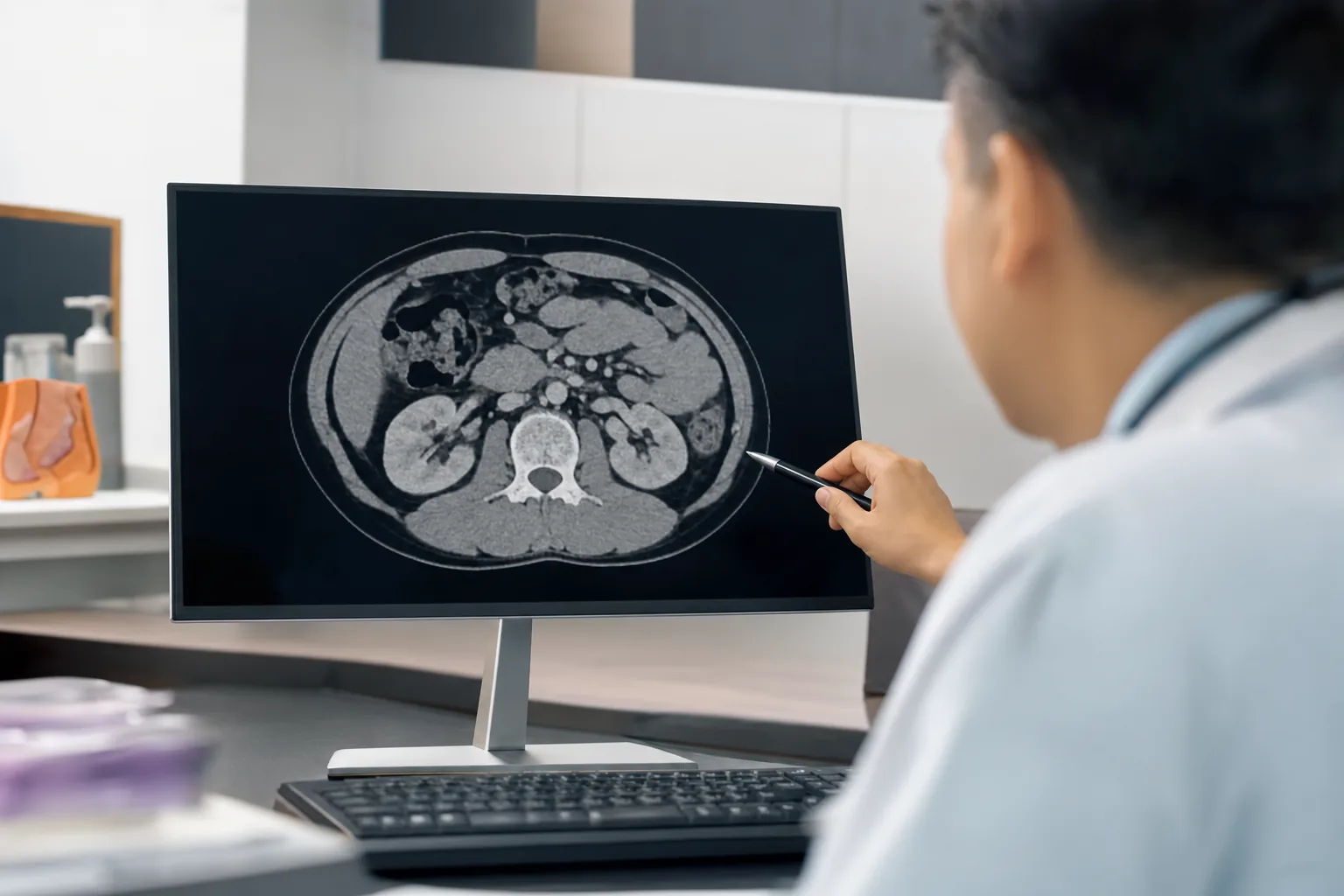
Abdominal CT can show injuries to the spleen, liver, kidneys, or other internal organs in cases of trauma, and in emergencies it can reveal internal injuries and bleeding quickly enough to help save lives. For kidney trauma, CT with intravenous contrast is the gold standard for stable patients, and the scan should include four phases, the last a delayed phase 5 to 10 minutes after the injection.
The bowel is harder to see. In 11,924 blunt trauma patients, free fluid on CT had a sensitivity of 66% for bowel injury requiring surgery, and bowel wall thickening had a sensitivity of 35%. Repeating the CT scan has been recommended if clinical improvement is not apparent within an 8-hour window. The page on radiology imaging after a car accident explains how the different scans compare.
Observation, Embolization, and Surgery
Treatment depends on the extent of the injury. Some minor spleen tears might stop bleeding on their own, and only the most severe grade V ruptures require removal of the spleen.
For grade III and IV spleen injuries, splenic embolization can help manage the bleeding before or instead of surgery. An interventional radiologist steers a catheter into the blood vessel and injects tiny, sponge-like beads to stop the blood flow. Splenorrhaphy, a surgical repair with stitches, electrocautery, or topical agents, may be needed as well. Only about 20% of spleen ruptures end with removal of part or all of the spleen, and because it is an emergency operation, it is likely to be open abdominal surgery.
Nonoperative management should be the treatment of choice for hemodynamically stable minor, moderate, and severe liver injuries when no other internal injuries require surgery. Patients who are hemodynamically unstable and do not respond to resuscitation should undergo an operation.
Most failures of nonoperative care for spleen injuries occur early, primarily in the first 24 hours, and the risk of failure and splenectomy is highest in the first 24 to 72 hours of admission. For adults, 1 to 3 days of hospital admission is suggested, from low-grade to high-grade spleen injuries, with the length of stay based on hemodynamic status, hemoglobin and hematocrit stability, and follow-up imaging at 48 to 72 hours.
For kidney trauma, angioembolization has a success rate of 89% the first time and 82% when repeated, and its effectiveness has been shown even in higher grade kidney trauma.
Healing Ranges After Hospital Discharge
Depending on the extent of the injury and treatment, recovery from a ruptured spleen may take anywhere from three to 12 weeks. Minor spleen injuries heal relatively quickly, while a person who has surgery will probably remain in the hospital for a few days afterward.
For adults with higher grade spleen injuries treated without surgery, CT with contrast or ultrasound is suggested before returning to major physical activity, which is placed at 2 to 4 months for high-grade injuries. Readmission after nonoperative care is relatively rare and most often occurs within 7 days of discharge.
Delayed Rupture, Bile Leaks, and Infection
Complications occur in 12% to 14% of patients with blunt liver trauma, particularly after a high-grade injury. Re-bleeding, as in a subcapsular hematoma or a ruptured pseudoaneurysm, is the most frequently reported complication after nonoperative management (range 1.7% to 5.9%). Biliary complications, including biloma, biliary fistula, and bile peritonitis, have an incidence of 2.8% to 30%, and most traumatic bilomas regress spontaneously.
Routine follow-up CT is not necessary unless a complication is suspected, but abdominal pain, fever, jaundice, an abnormal inflammatory response, or a drop in hemoglobin calls for a repeat scan.
Living without a spleen increases the risk of blood clots and infections, including a severe form of sepsis called overwhelming post-splenectomy infection that can be fatal without treatment. People without a spleen are two to three times more likely to get an infection or a related complication, and pneumococcus, Haemophilus influenzae type b, and meningococcus vaccines, along with annual flu shots, are among the vaccines needed afterward.
Early complications of kidney trauma include bleeding, infection, perinephric abscess, sepsis, urinary fistula, hypertension, urinary extravasation, and urinoma. Delayed complications include bleeding, hydronephrosis, stone formation, chronic pyelonephritis, hypertension, arteriovenous fistula, and pseudoaneurysms, although kidney trauma is a rare cause of hypertension, estimated at less than 5%.
Records That Track Each Stage
The first visit sets the baseline. Severe upper left abdominal pain or Kehr’s sign, even if it occurs sometime after the original injury, is a reason to go straight to the emergency room and tell the doctors about the symptoms and any recent injuries.
Lab values become part of the chart early. For high-grade spleen injuries treated without surgery, patients might receive continuous monitoring of vital signs and hemoglobin and hematocrit checks every 8 hours.
Follow-up entries track the weeks after discharge. When a patient with a spleen injury goes home early, explicit education about the risk of rupture outside the hospital is suggested, along with a clinical, telephone, or nurse follow-up 5 to 7 days after discharge in every case. Operative reports, embolization notes, and vaccination records fill in the months between.
A short daily log of abdominal pain, shoulder pain, dizziness, and any blood in the urine gives later providers a timeline to check against the hospital chart. Kept with the CT reports and discharge papers, that log puts the full course of an internal injury in one place.
Still Recovering From an Internal Injury?
An internal organ injury can mean days of monitoring, an embolization or emergency surgery, months before normal activity, and for some people a life without a spleen. An insurer may still judge the whole injury by a single CT report. Sam Aguiar Injury Lawyers gathers the imaging, the hospital and operative records, and the follow-up visits so each stage of your recovery is on paper. Under our Bigger Share Guarantee®, you always walk away with more than the firm after bills, liens, and case costs. Start with a free case review.