

Car Accident Splenic Injuries
Key Takeaways
- The spleen is a secondary lymphoid organ responsible for the regulation of immune responses and blood filtration, and it is the most commonly injured solid organ following blunt abdominal trauma.
- Nonoperative management is the standard of care for the hemodynamically stable patient with an isolated blunt splenic injury, and up to 38 percent of high-grade injuries are successfully managed without an operation.
- After the spleen is removed, the risk of an overwhelming post-splenectomy infection ranges from 10 to 50 times higher than in the general population, so vaccination and an antibiotic plan for sudden fevers become part of care afterward.
What the Spleen Does
The spleen is a secondary lymphoid organ responsible for the regulation of immune responses and blood filtration. It is also the most commonly injured solid organ following blunt abdominal trauma, and the mechanisms include car accidents and pedestrian accidents, as well as motorcycle accidents and sports injuries.
Those two roles explain the two consequences of a splenic laceration. A tear in a solid organ that handles blood can bleed, and splenic injuries can be fatal not only at admission to the emergency department but also from delayed rupture of a subcapsular hematoma or pseudoaneurysm. If the organ is lost, asplenia increases susceptibility to severe and invasive infections, especially those caused by encapsulated bacteria, namely Neisseria meningitidis, Streptococcus pneumoniae, and Haemophilus influenzae type b.
Asplenia is predominantly due to splenectomy for traumatic events or oncohematological conditions, which makes the immune effect the part of a splenic case that lasts longest after the hospital stay.
Injury Grading
Trauma teams describe a splenic injury on a five-grade scale, and the organ injury scale of the American Association for the Surgery of Trauma was updated in 2018 for the spleen, liver, and kidney. The classification describes each grade by the size of the hematoma, the depth of the laceration, and whether vessels are involved.
| Grade | Hematoma | Laceration |
|---|---|---|
| I | Under the capsule, under 10 percent of the surface | Capsular tear, under 1 cm deep |
| II | Under the capsule, 10 to 50 percent of the surface, or inside the organ under 5 cm across | 1 to 3 cm deep, not involving a vessel in the organ |
| III | Under the capsule over 50 percent or expanding, ruptured, or inside the organ over 5 cm | Over 3 cm deep or involving trabecular vessels |
| IV | Not listed separately | Segmental or hilar vessels, with over 25 percent of the spleen losing its blood supply |
| V | Not listed separately | Completely shatters the spleen, or hilar vessel injury that cuts off its blood supply |
A grade is not the whole picture. A patient’s condition may lead to an emergency transfer to the operating room without the opportunity to define the grade of the splenic lesion, and minor lesions associated with hemodynamic instability often must be treated with operative management. In the other direction, hemodynamically stable patients with high-grade lesions could be successfully treated nonoperatively.
The grade also does not predict how the injury will go: injury grade on CT scan, extent of free fluid, and the presence of a pseudoaneurysm do not predict failure of nonoperative management or the need for an operation. What distinguishes one Grade III injury from another is in the treatment record.
Treatment Approaches
Trauma care has moved toward keeping the spleen where that is safe. Nonoperative management is the standard of care for the hemodynamically stable patient with an isolated blunt splenic injury, and up to 38 percent of high-grade injuries are successfully managed nonoperatively. Patients with low-grade injuries are successfully discharged in 1 to 2 days and those with high-grade injuries in 3 to 4 days.
Monitoring is an active treatment. An international consensus panel suggested that adult patients be admitted to hospital for 1 day for low-grade injuries to 3 days for high-grade injuries, with high-grade injuries requiring a monitored setting, and that follow-up ultrasound or CT with contrast 48 to 72 hours after admission is the best strategy for timely detection of vascular complications in grade III or higher injuries.
Splenic artery embolization sits between monitoring and surgery: a catheter blocks the bleeding vessel while the organ stays in place. Embolization has become the mainstay treatment for hemodynamically stable patients with high-grade blunt splenic trauma, with splenectomy the mainstay for unstable patients. Splenectomy, the removal of the whole spleen, is the operation when bleeding cannot be controlled.
A cohort study of 7,567 patients with isolated severe blunt splenic injury compared the three approaches.
| Approach | Patients | Morbidity compared with open splenectomy |
|---|---|---|
| Observation | 4,521 | Lower (odds ratio 0.71) |
| Splenic angioembolization | 1,547 | Lower (odds ratio 0.61) |
| Open splenectomy | 1,499 | Comparison group |
Nonoperative management was associated with favorable outcomes compared with surgery, even in patients with hypotension on admission. Failure of nonoperative management, however, risked higher morbidity without an associated increase in mortality, and a case that failed monitoring carries a record of that failure.
Delayed Rupture After an Accident
Most splenic injuries manifest at the moment of injury with symptoms of acute intraperitoneal hemorrhage and shock. In the other course, there may be an asymptomatic period between the initial injury and the appearance of signs of internal hemorrhage, and a minority of patients experience delayed rupture, which occurs days to weeks after the initial trauma.
In a case series of 12 adults with delayed traumatic splenic rupture, most injuries were from falls or car accidents, occurring 2 to 7 days before admission. All of them had left-sided abdominal pain and were diagnosed using imaging, and they arrived with initial hemoglobin levels only slightly low.
Injuries that look minor at first are not immune: some patients with a lower-grade injury might end up with delayed splenic rupture. Delayed splenic hemorrhage remains a feared complication, but the 180-day readmission rate for splenectomy is low, with the majority returning within 8 days of the injury.
Symptoms Needing Prompt Attention
- New pain in the left upper abdomen
- Pain in the left shoulder with no shoulder injury
- Light-headedness or fainting
- Left-side belly pain that returns days after a first discharge
Diagnosis and Imaging
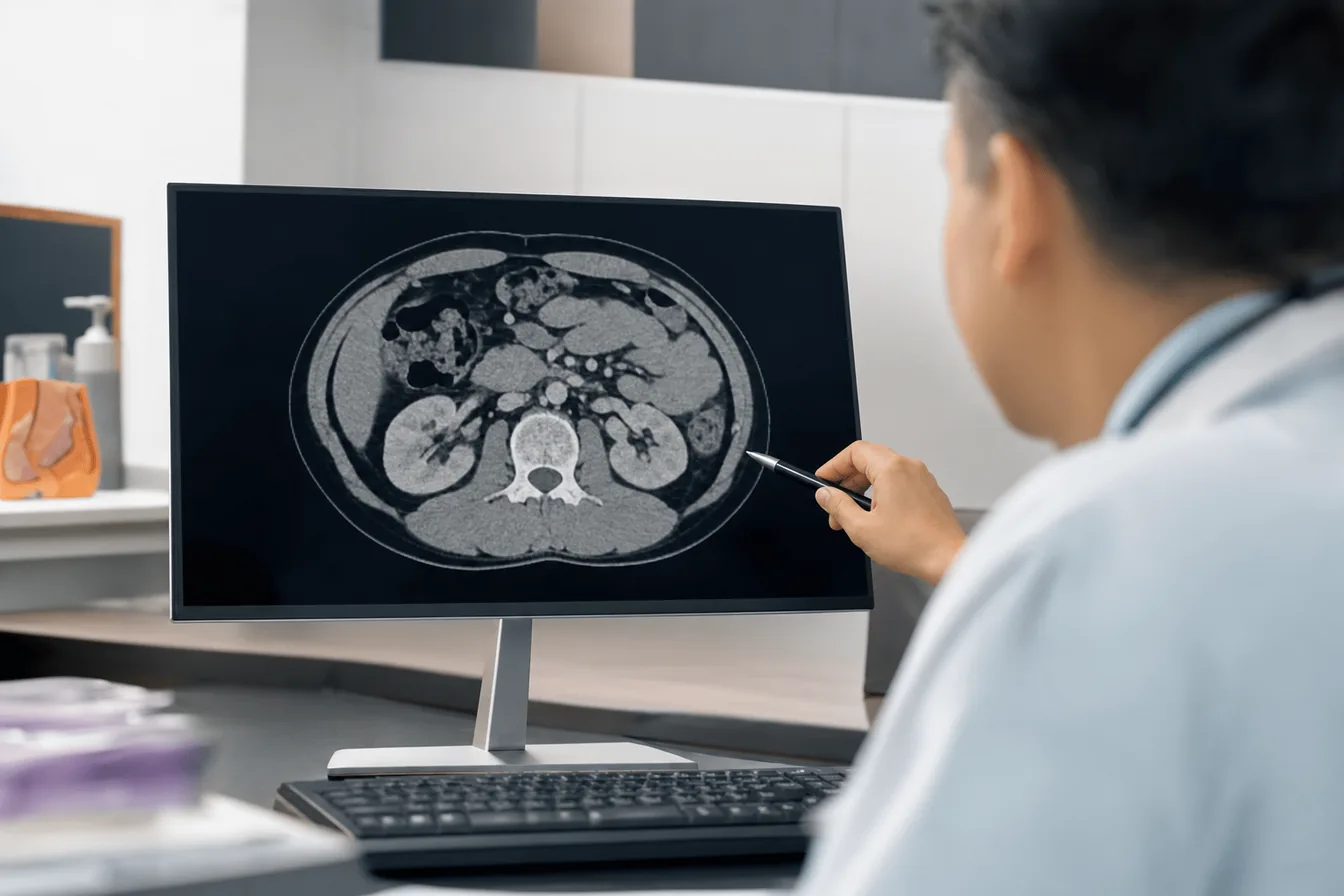
Two tests shape the first hours. Extended focused ultrasound has been accepted in multiple studies as the initial diagnostic tool for torso injuries in blunt abdominal trauma, and it is effective and rapid in detecting free fluid, which in this setting means blood. A CT scan with intravenous contrast is the gold standard in hemodynamically stable or stabilized trauma patients, and it is the study that describes the organ injury and produces the grade.
The presentation varies. A patient with a splenic injury may complain of abdominal or left upper quadrant pain, may have referred left shoulder pain when the left upper abdomen is pressed, which is called Kehr’s sign, or may show hemodynamic instability. Because of that spread of symptoms, the first note is only as good as what was asked and written down.
A single reading on arrival can also understate the injury, as the delayed rupture series above shows, and repeat imaging is part of how the course is documented. That record is why radiology records carry weight in an injury case.
Why Kentucky Hires
Sam Aguiar Injury Lawyers
Immune Changes After Splenectomy
The immune effect is the part of a splenic case that a first evaluation tends to leave out. Asplenic or splenectomized patients have a risk of overwhelming post-splenectomy infection ranging from 10 to 50 times higher than the general population, and Streptococcus pneumoniae is the most frequent cause of those infections.
Vaccination is the main protection, and it is not reliably given. Across 24 studies in a meta-analysis, most identified a lack of adherence to international guidelines by healthcare workers.
| Vaccine | Coverage |
|---|---|
| Pneumococcal | 55.1 percent |
| Haemophilus influenzae type b | 48.3 percent |
| Meningococcal C or ACYW135 | 33.7 percent |
| Meningococcal B | 13.3 percent |
| Influenza | 53.2 percent |
Timing matters. After a traumatic splenectomy, vaccination should be given no sooner than 14 days afterward, because before that the antibody response is thought to be suboptimal, and patients should be informed that immunization can only reduce the incidence of overwhelming post-splenectomy infection. Asplenic patients should be given an antibiotic supply in case of any sudden onset of unexplained fever, malaise, chills, or other constitutional symptoms, and most episodes of severe infection occur within the first 2 years after splenectomy.
Where the spleen is kept, the picture differs: immune function may be preserved following splenic artery embolization. Where splenic function is lost either way, vaccination against common infective microorganisms and antibiotic therapy when needed are considered beneficial in diminishing the frequency and gravity of the infections.
Recovery and Activity Limits
Recovery is measured by activity limits, and the literature does not give one date. Reported returns to normal activity range from 3 weeks after splenectomy and 2.5 to 3 months after nonoperative management to an activity restriction of 2 weeks for mild injuries with a return to full activity after 6 weeks, and up to 4 to 6 months for more severe injuries.
Early movement is also graded by severity: mobilization after 24 hours is suggested in low-grade splenic trauma, while in high-grade injuries it is considered safe once three successive hemoglobin readings 8 hours apart are within 10 percent of each other.
Records for Car Accident Splenic Injuries
A splenic case is built from records created in the first days. The trauma and admission records show how the accident happened, the first examination, and the findings that prompted imaging. The imaging in original form carries the grade, and the repeat scan shows whether the injury changed. The hemoglobin trend across the admission shows more than a single reading, and the operative report matters where surgery happened.
After a splenectomy the file keeps growing: the vaccine dates, the antibiotic supply, and the discharge instructions that say what symptoms mean a return to the hospital. A long wait between the first visit and follow-up care leaves a gap in treatment that an insurer can point to.
A splenic injury often travels with others from the same accident, because blunt abdominal trauma can injure the spleen, liver, and kidneys, and a seat belt injury can range from bruising and abrasions along the belt’s path to intra-abdominal trauma and vertebral fractures.
Photos of any bruising on the abdomen or left side, the discharge papers, the vaccine card and pharmacy receipts after a splenectomy, and a short weekly note on pain, energy, and what the body could not do fill the space between medical visits. Those everyday details fade first.
Left-Side Pain Days After the Accident?
Car accident splenic injuries can be charted as a bruised belly at the first visit and turn into a bleed days later, and an insurer may still value the injury by that first note. You focus on getting better. We handle everything else. With our Bigger Share Guarantee®, you always get more, and you pay $0 out-of-pocket forever. Start with a free case review.