

Truck Crash Discovery and Subpoenas

Discovery in a Kentucky truck crash case is the legal process where attorneys obtain evidence from trucking companies, insurance carriers, and other parties before trial. Under the Federal Motor Carrier Safety Regulations (FMCSR), motor carriers must retain driver logs, inspection reports, maintenance records, and qualification files for specific periods. Subpoenas, interrogatories, requests for production, and depositions obtain this evidence before carriers can destroy it, alter it, or claim it no longer exists.
Discovery Rights Under Kentucky Civil Rules
The Kentucky Rules of Civil Procedure (CR 26 through CR 37) grant attorneys broad discovery rights. In truck crash litigation, those rights carry extra weight because the trucking company controls almost all of the evidence. The driver’s logs, the vehicle maintenance history, the dispatch records, the safety audit results, and the drug test files all sit in the carrier’s hands until a subpoena or preservation demand forces the carrier to produce them.
Standard Carrier Documents in Discovery
Discovery in a truck crash case reaches a standard set of carrier documents. These records show how the crash happened and who is responsible, and they sit alongside the broader questions of trucking accident liability.
Driver Qualification File
Under 49 CFR Part 391, motor carriers must maintain a driver qualification (DQ) file for every driver. This file contains the driver’s application for employment, motor vehicle record (MVR), road test certification, medical examiner’s certificate, and annual review of driving record. It shows whether the carrier verified the driver was qualified to operate a commercial motor vehicle, and whether red flags in the driver’s history were ignored.
The FMCSA Safety Measurement System (SMS) tracks carrier compliance scores across seven categories, including Driver Fitness.
Maintenance and Inspection Records
Under 49 CFR Part 396, carriers must perform systematic inspections, repairs, and maintenance on every commercial vehicle. Driver vehicle inspection reports (DVIRs), annual inspection certificates, and repair work orders all go into the vehicle maintenance file.
FMCSR Compliance Records
The Federal Motor Carrier Safety Administration requires carriers to maintain extensive compliance records beyond standard business documents. These records are often the strongest evidence in a truck crash case.
Compliance, Safety, Accountability (CSA) Scores
The FMCSA’s CSA program tracks carrier safety performance using data from roadside inspections, crash reports, and compliance reviews. Carriers receive percentile scores in seven Behavior Analysis and Safety Improvement Categories (BASICs): Unsafe Driving, Hours-of-Service Compliance, Driver Fitness, Controlled Substances/Alcohol, Vehicle Maintenance, Hazardous Materials Compliance, and Crash Indicator.
Drug and Alcohol Testing Records
Under 49 CFR Part 382, CDL drivers must undergo pre-employment drug testing, random drug and alcohol testing, suspicion-based testing, and post-accident testing. Carriers must maintain records of all tests, including any positive results, refusals to test, and return-to-duty protocols.
Safety Audit and Compliance Review History
FMCSA conducts compliance reviews and safety audits of motor carriers under 49 CFR Part 385. The results of those audits, along with any audits the carrier conducted itself, are discoverable. They often contain candid assessments of safety deficiencies that the carrier knew about and failed to correct.
Electronic Logging Device Data and Hours-of-Service Records
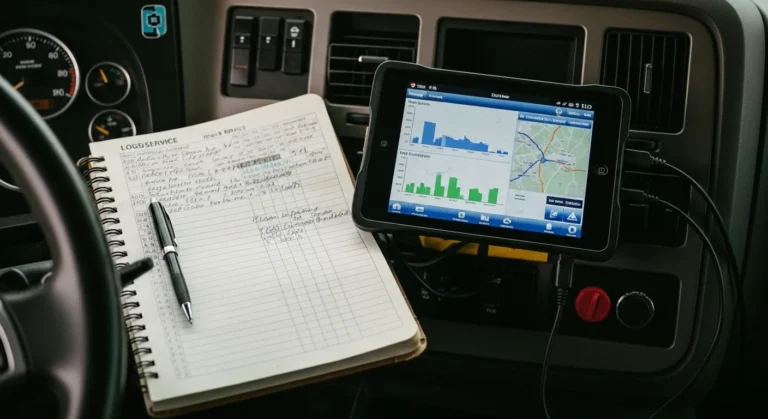
Since the FMCSA ELD mandate took full effect in December 2019, most commercial motor vehicles must use electronic logging devices to record driving time. ELDs replaced paper logbooks and are designed to prevent drivers from falsifying their hours of service.
ELD data is strong evidence because it is difficult to falsify completely. Even when drivers or carriers attempt to manipulate the data, the underlying engine and GPS records often reveal the true driving pattern. Cross-referencing ELD data against fuel receipts, toll records, and dispatch communications identifies discrepancies that indicate hours-of-service violations.
Record Retention and Evidence Destruction
Federal regulations require carriers to retain certain records for specific periods. Under 49 CFR 395.8(k), ELD data and supporting documents must be retained for at least six months. Driver qualification files must be kept for the duration of employment and three years after termination under 49 CFR Part 391. Maintenance records must be retained for one year under 49 CFR 396.3, and accident registers for three years under 49 CFR 390.15.
Destroying evidence after a preservation demand or when litigation is anticipated is called spoliation. A spoliation preservation demand is a written notice to the trucking company, its insurer, and any third-party data holder to preserve all evidence related to the crash before the retention periods run out.
Event Data Recorder Downloads
Most modern commercial trucks have an event data recorder, similar to a black box in an airplane. The EDR captures vehicle speed, brake application, throttle position, steering input, and other data points in the seconds before and during a crash. The National Highway Traffic Safety Administration describes how event data recorders capture this information, and EDR data is a central piece of crash reconstruction evidence.
Ready to Take Action on Your Injury Claim?
After a serious injury, medical bills pile up while the insurance company looks for ways to pay you less. Most law firms take their cut first and leave you with whatever is left. Sam Aguiar Injury Lawyers does things differently. With our exclusive Bigger Share Guarantee®, you always get more. Every client gets a dedicated three-person team: an attorney, a case manager, and a legal assistant. We never raise our fee rate if we have to go to court, and you pay $0 Out-Of-Pocket Forever.
Frequently Asked Questions
1What is discovery in a truck crash case?+
2What documents are subpoenaed in a Kentucky truck crash case?+
3How long must trucking companies keep ELD and driver records?+
4What happens if a trucking company destroys evidence after a crash?+
5Who gets deposed in a truck crash case?+
6What is a spoliation preservation demand?+
Latest Articles

Kentucky Diminished Value Claims
Kentucky drivers may pursue a repaired vehicle’s leftover market loss from the at-fault driver as part of a.
FMCSA Revoked ELDs: Fleet Compliance and Enforcement Deadlines
FMCSA removed five electronic logging devices from the registered list on August 6, 2026, and set an October.

FMCSA English Proficiency Rule and OOS Enforcement
FMCSA English Proficiency Rule Sam Aguiar Injury Lawyers August 11, 2026 7 minute read On This Page.