

Investigating Truck Crashes

Fleet management system (FMS) data gives a truck crash investigation objective, synchronized records of what a commercial truck and its driver were doing before, during, and after a crash. GPS logs show speed and route. ELD records show whether the driver was within the 49 CFR Part 395 hours-of-service rules. ECM data captures throttle, braking, and engine fault codes. Dashcam footage shows what was happening inside and outside the cab. Much of this data can be purged on routine cycles, so preservation demands need to reach the carrier quickly.
Fleet Management System Data Sources
A commercial truck running a modern fleet management platform generates a continuous data stream across several systems, and each stream answers a different question in a crash investigation.
GPS and Route Data
GPS data shows where the truck was, how fast it was going, and whether it left its assigned route. Latitude and longitude coordinates, speed history, and timestamps for every stop and departure give investigators a second-by-second account of the truck’s movements.
ELD Records
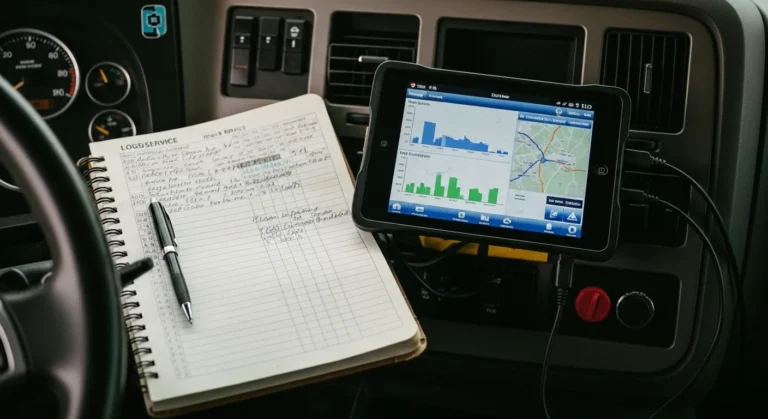
ELD records, required under 49 CFR Part 395, show whether the driver was legally on duty and whether actual driving time matched logged hours. They include on-duty driving time, off-duty time, sleeper berth periods, and engine hours compared with logged driving time. Discrepancies indicate falsification, and the metadata tracks who made changes and when.
ECM and Telematics Data
The engine control module records what the engine was doing, whether the driver was speeding, and whether the brakes were applied before impact. Throttle position, engine RPM, brake application force and timing, cruise control status, and accumulated fault codes, including codes that triggered days before the crash, are all stored in the ECM.
Event Data Recorder Snapshot
Event data recorder (EDR) data covers the final seconds before a crash, typically 5 to 30 seconds of vehicle speed, braking force, and steering input. The recorder triggers on sudden decelerations above a threshold and keeps the snapshot until the module is cleared or replaced.
Dashcam Footage
Dashcams show whether the driver was distracted and what road conditions looked like at impact. Forward-facing cameras capture traffic and the crash sequence. Driver-facing cameras capture fatigue indicators, phone use, and distracted behavior. Event-triggered clips on platforms like Samsara and Lytx upload automatically to the cloud, while non-triggered footage can overwrite within 24 to 72 hours.
Driver and Carrier Negligence Evidence
FMS data often shows negligence by the driver, the carrier, or both, and each form of negligence opens a separate path to recovery.
Driver Negligence
- Speeding: GPS and ECM data show speed at impact compared with the posted limit and a safe speed for conditions.
- Hours-of-service violations: ELD logs compared against engine hours reveal falsified driving time.
- Distracted driving: inward-facing dashcam footage shows phone use or fatigue in the seconds before impact.
- Aggressive driving: event score history shows repeated hard-braking events that management saw and never corrected.
Carrier Negligence
- Ignored fault codes: diagnostic trouble codes for brake pressure loss, tire pressure, or ABS faults reached fleet managers before the crash.
- Dispatch pressure: FMS messaging logs show the driver was pushed to keep pace despite hours-of-service limits.
- Supervisory failure: pattern data shows repeated violations that management reviewed and ignored.
- Deferred maintenance: scheduled maintenance was skipped despite automated FMS reminders, as documented in DVIR records.
Knew or Should Have Known Standard
Under 49 CFR 390.11, a motor carrier must require its drivers to observe the federal safety regulations. When FMS data shows a carrier received fault code alerts and speeding event scores and took no action, that evidence supports direct carrier liability under the “knew or should have known” standard, and in egregious cases, punitive damages.
Preservation Demands and Spoliation
A written preservation demand is the first legal step in a truck crash investigation, and it has to reach the carrier, the driver, the freight broker, and the FMS platform provider before evidence disappears. The demand identifies:
- All GPS route data and speed logs
- Complete ELD logs, including metadata and edit history
- ECM and EDR data from the specific unit
- All dashcam footage, including cloud backups
- Driver behavior scoring for the preceding 90 days
- All diagnostic trouble codes generated in the 30 days before the crash
- All maintenance schedules and repair records
Once a carrier has written notice of a claim or potential litigation, it has a duty to preserve relevant evidence. A carrier that destroys FMS data after that notice risks a spoliation finding, and courts can respond with an adverse inference instruction telling the jury it may assume the destroyed data would have been unfavorable to the carrier. That remedy depends on a preservation demand being on record first.
The page on modern fleet management systems explains how these platforms work, ECM evidence in truck cases covers the black box, and the trucking data breakdown shows how the records fit together.
Ready to Take Action on Your Injury Claim?
After a serious injury, medical bills pile up while the insurance company looks for ways to pay you less. Most law firms take their cut first and leave you with whatever is left. Sam Aguiar Injury Lawyers does things differently. With our exclusive Bigger Share Guarantee®, you always get more. Every client gets a dedicated three-person team: an attorney, a case manager, and a legal assistant. We never raise our fee rate if we have to go to court, and you pay $0 Out-Of-Pocket Forever.
Frequently Asked Questions
1What is FMS data in a truck crash case?+
2How quickly does FMS data get overwritten?+
3Can a trucking company delete this data after a crash?+
4What is the difference between an ELD, ECM, and EDR?+
Latest Articles
Kentucky Diminished Value Claims
Kentucky drivers may pursue a repaired vehicle’s leftover market loss from the at-fault driver as part of a.
FMCSA Revoked ELDs: Fleet Compliance and Enforcement Deadlines
FMCSA removed five electronic logging devices from the registered list on August 6, 2026, and set an October.

FMCSA English Proficiency Rule and OOS Enforcement
FMCSA English Proficiency Rule Sam Aguiar Injury Lawyers August 11, 2026 7 minute read On This Page.